23.08. – 25.08.2019
Julian Rosefeldt – Deep Gold
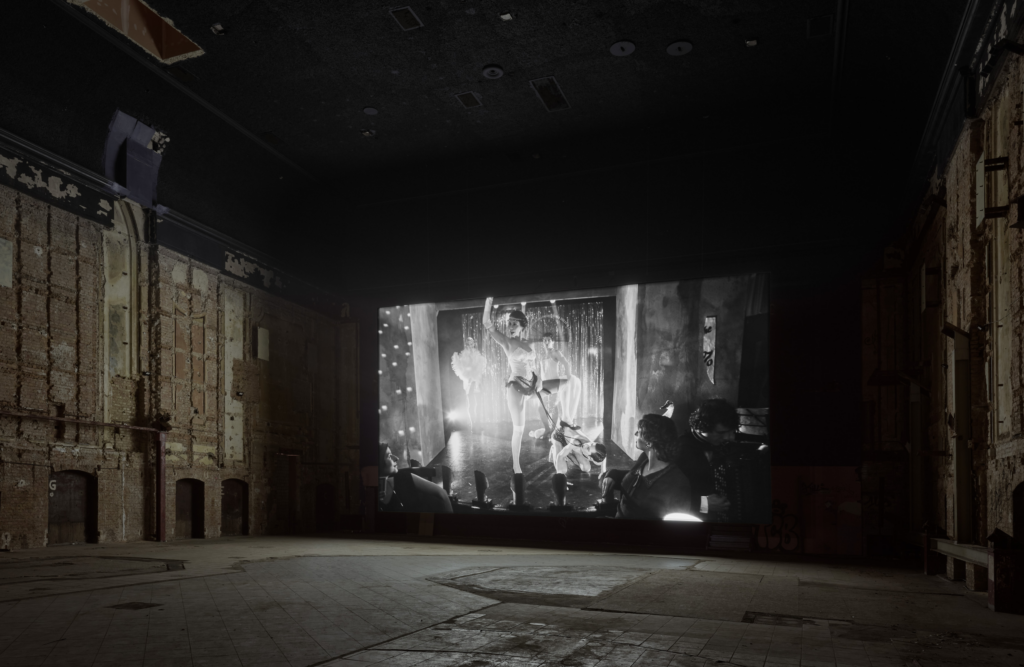
On the monumental walls of the historic ballroom at Hasenheide, Julian Rosefeldt’s black-and-white film Deep Gold unfolds impressively. It is a homage to a scene from Luis Buñuel’s surrealist classic L’Âge d’Or (1930). Rosefeldt transposes the events to a nightclub in 1920s Berlin, in whose metropolitan setting various parallel worlds interact.
The film thus extends what is already suggested in the Spanish surrealist’s unsparing cinematic critique of society and religion: the challenge to a repressive sexual morality, the dissolution of the established gender order, and the appeal for an emancipation that never excludes the power of female sexuality. Rosefeldt draws parallels between the economic situation of the 1920s and today.
The cinematic leaps between times and spaces always reveal something about human sensibilities. The longings of people, which have their fixed place in Hollywood cinemas, Rosefeldt translates into reception-aesthetic categories of the visual arts.
The film “Deep Gold,” which has already been shown several times in Berlin, is now for the first time placed in dialogue with the second part of the four-part cinematic homage to Max Beckmann “Meine Kunst kriegt hier zu fressen,” which Julian Rosefeldt developed together with his former artistic partner Piero Steinle for the 2002 Beckmann retrospective at the Centre Pompidou in Paris. The video presents a collage of historical film material from revue theaters of the 1920s. Scantily clad women ride on carousel horses or perform topless acrobatic feats.
The interplay of the exhibition space—a former ballroom—and the two films “Deep Gold” and “Meine Kunst kriegt hier zu fressen – Hommage an Max Beckmann” evokes a legendary past, yet not without drawing parallels to the present, by questioning, for instance, the cultural consequences of the sexual revolution.